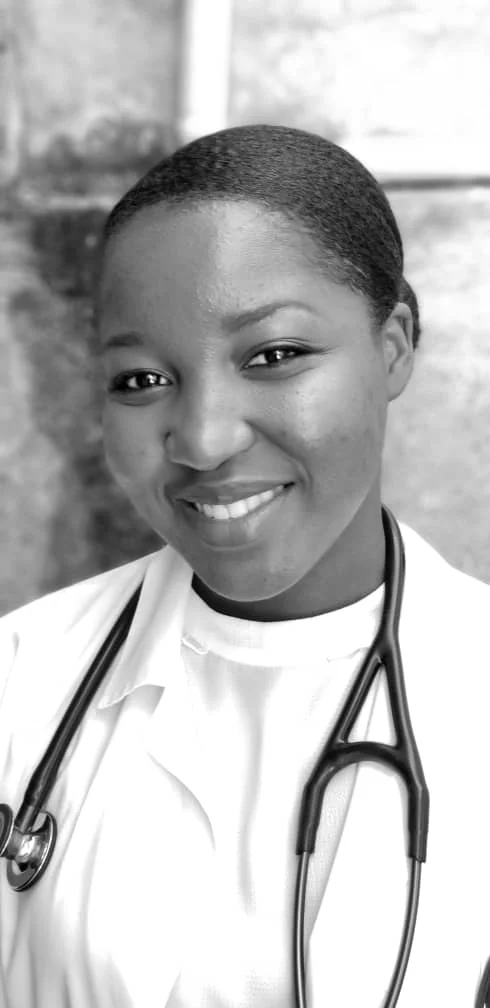
Med talk with Dr. Danièle Jasmin
Side note: This interview was written a year ago.
Daniele and I are two Aquarius women that have known each other since we were very young. She has always aspired to be a doctor and this post is really to confirm that the already scarce health system is governed by young adults with very little support from the government.
1- Describe your academic path to becoming a doctor.
Right after high school, I decided that I wanted to be a doctor. There are three well known medical schools in Haiti: Faculté de Médecine et de Pharmacie (FMP) de l’ Université d'État d'Haïti, Faculté de Médecine et des Sciences de la Santé of Université Notre Dame d'Haïti (UNDH) and Faculté des Sciences de la Santé of Université Quisqueya (UNIQ). In order to be admitted to the program, you must pass an exam and the best scores will be selected. The number of applications received may vary, FMP receives about 5000 and UNDH about 1000. When I wanted to apply for FMP, there was a strike that closed the doors of the university. I applied only for UNDH and got accepted. It wasn't easy, especially the first year, because you're new, you're not used to the system and they tell you that if you want to succeed, you MUST adapt, not everyone does unfortunately. The first 2 years were mostly theory and practice as nursing care and dissection on cadavers. In the third year, I went to the hospital to practice the clinical evaluation. As the year went by, I learned so much about how to approach a patient under the supervision of other doctors in Cap Haitien during an internship. I fast forward to my seventh. year. To be recognized by the Ministry of Health of Haiti, you. have to work for the government for a year. After that year, you are titled a generalist. Now you decide between staying as a generalist or becoming a specialist. I chose to be a specialist in internal medicine and passed another exam, and here I am on my 1st year of residency as an internist. The thing that was not fair about the exam is, since I'm from a private University, I had a different exam than those from The FMP, and all of them, even the worst scores had the opportunity to choose before me. And some specialties such as ophthalmology, radiology, anatomy pathology were not available for even the top ten from private universities or those who studied in different universities/countries than FMP.
2- Can you walk us through your experience as a working doctor in Haiti.
Being a Doctor in Haiti, especially when you're young is quite frustrating sometimes. When you work in a public hospital, you see all the impairments and the weakness of the health system. We make miracles with the resources we have. As a young doctor, I'm still experiencing the medical system.
3- Does doing medicine pay your bills as a young adult in Haiti?
An intern in medicine is paid around 7000 gourdes, a generalist working for the government is paid: 10 000 gourdes, a first resident is around 12400 gourdes. Has anyone ever wonder the minimum requirements to rent a house in Haiti, especially when you have a whole family? 86 gourdes is equal to 1 USD, go figure. Just to tell you that it's not enough for a doctor who studied and worked hard for at least 7 years to get a doctorate. It's not about the vow, but when you work, you must obtain enough satisfaction besides the good evolution of the patients. But, it seems that when you are a specialist, you'll earn a little bit more than that. It's like 13-15 years of study for a brighter future.
4- Does your family and close friends respect your career choice?
My family and close friends are proud and more than respect my career choice. And when I'm complaining, they give me strength. They're my strength beside the smiles on my patient's faces.
5- What hope do you have for Haiti?
I'm sure everybody has only one hope for Haiti: a better Haiti like it was before. For the doctors, I want more hospitals. There's a lot of regions in Haiti where kids never get vaccinated, women don't get the chance to arrive at a hospital to deliver but instead die on the way and sometimes even the babies die. Too many people die because primary health care is unavailable and it saddens me. Or worst than that, they're uneducated and when they don't feel good they think it's something maleficent or wait for it to get worse before seeking help. There are NOT enough hospital well equipped, there are NOT enough doctors for the people out of the big cities such as Port-au-Prince, Cap-Haïtien, Mirebalais, Cayes, Jacmel. We need to do better than that.